Additional Specifications of Power Amplifiers


The list of additional specifications of power amplifiers can be endless. However, we will mention here some of them which are more important.


Damping Factor


A flat frequency response is desirable to avoid tonal coloration, but a flat response may not always be obtained when the amplifier is driving a real-world loudspeaker load. The input impedance of real loudspeakers can vary dramatically as a function of frequency, while the output impedance of the power amplifier is nonzero. A voltage divider is thus formed by the amplifier output impedance and the loudspeaker input impedance. Here the amplifier is modeled with an ideal amplifier with zero output impedance in series with impedance Zout that describes its actual output impedance (referred to as a Thévénin equivalent circuit). This is where the damping factor (DF) comes into play. In spite of its important-sounding name, this is just a different way of expressing the output impedance of the amplifier.
While amplifiers ideally act like voltage sources with zero output impedance, they all have finite output impedance. The term damping factor came from the fact that a loudspeaker is a mechanically resonant system; the low output impedance of an amplifier damps that resonance via the resistance of the loudspeaker’s voice coil and electromotive force. An amplifier with higher output impedance will provide less damping of the loudspeaker cone motion because it adds to the total amount of resistance in the circuit. Damping factor is defined as the ratio of 8 Ω to the actual output impedance of the amplifier. Thus, an amplifier with an output impedance of 0.2 Ω will have a DF of 40.
Most vacuum tube amplifiers have a DF of less than 20, while many solid-state amplifiers have a DF in excess of 100. It is important to bear in mind that the DF is usually a function of frequency, often being larger at low frequencies. This is consistent with the need to dampen the cone motion of woofers, but ignores the influence of the DF on frequency response at higher frequencies. Many loudspeakers have a substantial peak or dip in their impedance at or near their crossover frequencies. This could result in coloration if the amplifier DF is low.
The effect of damping factor and output impedance on frequency response must not be underestimated in light of the large impedance variations seen in many contemporary loudspeakers. It is not unusual for a loudspeaker’s impedance to dip as low as 3 Ω and rise as high as 40 Ω across the audio band. Consider this wildly varying load against the 0.4 Ω output impedance of a vacuum tube amplifier with a DF of 20. This will cause an audible peak-to-peak frequency response variation of ± 0.5 dB across the audio band.


Dynamic Headroom


Unlike a sine wave, music is impulsive and dynamic. Its power peaks are often many times its average power. This ratio is often referred to as the crest factor. Dynamic headroom refers to the fact that an amplifier can usually put out a greater short-term burst of power than it can on a continuous basis. The primary cause of this is power supply sag which is a reflection of power supply regulation. The power supply voltages will initially remain high and near their no-load values for a brief period of time during heavy loading due to the energy storage of the large reservoir capacitors. Under long-term conditions, the voltage will sag and less maximum power will be available. Consider an amplifier that clips at 100 W into 8 Ω on a continuous test basis. If this amplifier has a power supply with 10% regulation from no-load to full load (which is fairly good), the available power supply voltage will be about 10% higher during a short-term burst. This will result in a short-term power capability on the order of 120 W, since power goes as the square of voltage.
Dynamic headroom is a two-edged sword. It is good to have it because music tends to have an average power level much lower than the brief peak power levels it can demand (referring again to the crest factor). It is nice to have 20% to 40% more power available when it is needed for those brief peaks. On the other hand, a large amount of dynamic headroom is often symptomatic of an amplifier with a sloppy power supply.


Slew Rate


Slew rate is a measure of how fast the output voltage of the amplifier can change under large-signal conditions. It is specified in volts per microsecond. Slew rate is an indicator of how well an amplifier can respond to high-level transient program content. A less capable amplifier might have a slew rate of 5 V/µs, whereas a really high-performance amplifier might have a slew rate on the order of 50 to 300 V/µs. For a given type of program material, a higher-power amplifier needs to have a higher slew rate to do as well as a lower-power amplifier, since its voltage swings will be larger. A 100-W amplifier driving a loudspeaker whose efficiency is 85 dB will need to have 3.16 times the amount of slew rate capability as a 10-W amplifier driving a 95 dB speaker to the same sound pressure level.
As a point of reference, the maximum voltage rate of change of a 20 kHz sine wave is 0.125 V/µs per volt peak. This means that a 100-W amplifier that produces a level of 40 V peak at 20 kHz must have a slew rate of at least 5 V/µs. In practice a much larger value is desirable for low-distortion performance on high-frequency program content. Although technically imprecise, the rate of change of a signal is often referred to its slew rate for convenience.
The slew rate capability of audio power amplifiers received a lot more attention after the term transient inter-modulation distortion (TIM) was coined and studied intensely during the 1970s and early 1980s. This was largely another way of describing high-frequency distortion that resulted from slew rate deficiency.


Output Voltage and Current


Here we will briefly touch on the reality of output voltage and current swing that an amplifier may have to deliver in practice. The first table on Picture 1 shows the RMS value of the sine wave voltage, the peak voltage, the peak current, and the reserve current required for the popular 8 Ω resistive load as a function of power. The reserve current listed below is simply a factor of three greater than the peak current required of a resistive load and represents the reality of driving difficult reactive loudspeaker loads with non-sinusoidal wave forms. The reserve current can be assumed to occur only in a brief time interval under fairly rare circumstances.


Picture 1: Voltage and Current into a 8, 4 and 2 Ω Load


This data gives a glimpse of what is necessary for the amplifier to provide. Notice the very substantial voltage swings, and implied power supply voltages, required for a 400 W amplifier. The peak and reserve currents are also into the tens of amperes at 400 W. This is just the beginning of the story, however. The second table shows what the same amplifier would encounter when driving a 4 Ω load. Here we have assumed that the drive signal has remained the same and only the load impedance has dropped. We have also implicitly assumed that the amplifier has ideal power supply regulation, so all of the power numbers are doubled.
Given the nature of some of today’s high-end loudspeakers, some have argued that really high-performance amplifiers should be rated for power delivery into 2 Ω (at least for short intervals). Indeed, the testing done in some amplifier technical reviews regularly subjects power amplifiers to a 2 Ω resistive load test. The figures for output current become almost bewildering under these conditions. An important point here is that there are amplifiers sold every day that are rated at up to 400 W per channel into 8 Ω, and designers implement such amplifiers every day.
The sobering point is that if at the same time the designer thinks in terms of his amplifier being 2 Ω compatible, the potential demanded burst current could on occasion be quite enormous. This is illustrated in third table shown on Picture 1.

Basic Specifications of Power Amplifiers


Essentially, an audio amplifier is a normal voltage amplifier optimised for the amplification of audio signals. The limited frequency response of the ear sets the bandwidth limits: 20 Hz - 20 kHz, although most people are not able to hear 20kHz. Most power is concentrated in the mid frequencies, and occasionally in the low frequencies. Generally, the amplitude probability density function of audio signals is gaussian. This means that the ratio between maximum and average power is large: 10 … 20 dB. In average, it is 15 dB, which is 12dB below the power of a rail-to-rail sinewave. The primary specifications of an audio power amplifier include maximum power, frequency response, noise, and distortion.


Rated Output Power


The ear has a very large dynamic range. To give an example: the ratio between the acoustic power of a rock concert and the sound of breathing can be as large as 10^11. This makes large demands on the dynamic range of the audio amplifier.
Maximum output power is almost always quoted for a load of 8 Ω and is often quoted for a load of 4 Ω as well. A given voltage applied to a 4 Ω load will cause twice the amount of current to flow, and hence twice the amount of power to be delivered. Ideally, the output voltage of the power amplifier is independent of the load, both for small signals and large signals. This implies that the maximum power into a 4 Ω load would be twice that into an 8 Ω load. In practice, this is seldom the case, due to power supply sag and limitations on maximum available output current.
The correct terminology for power rating is continuous average sine wave power, as in 100 W continuous average sine wave power. However, many often take the liberty of using the term W RMS. Although technically incorrect, this wording simply is referring to the fact that the power would have been measured by employing a sine wave whose RMS AC voltage was measured on a long-term basis. There are other ways of rating power that are sometimes used because they provide larger numbers for the marketing folks, but we will ignore them here. When you hear terms like peak power just realize that these are not the same as the more rigorous continuous average power rating.


Frequency Response


The frequency response of a power amplifier must extend over the full audio band from 20 Hz to 20 kHz within a reasonable tolerance. Modern amplifiers usually far exceed this range, with frequency response from 5 Hz to 200 kHz not the least bit uncommon. The frequency response for such an amplifier is illustrated with the solid curve on Picture 1. While the tolerance assigned to the frequency response of loudspeakers is often ± 3 dB, the tolerance associated with power amplifiers is usually + 0 dB, – 3 dB, or tighter. Specifying where an amplifier is down by 3 dB from the nominal 0 dB reference is the conventional way of specifying the bandwidth of a system. This is often referred to as the 3-dB bandwidth. The frequency response for a less capable amplifier is shown with the dashed curve on Picture 1. This amplifier has a 3-dB bandwidth from 10 Hz to 80 kHz. Its response is down 1 dB at 20 Hz and 0.5 dB at 20 kHz.


Picture 1: Amplifier frequency response


Noise


It is important that power amplifiers produce low noise, since the noise they make is always there, independent of the volume control setting and the listening level. This is particularly so when the amplifiers are used with high-efficiency loudspeakers. The noise is usually specified as being so many decibels down from either the maximum output power or with respect to 1 W. The former number will be larger by 20 dB for a 100 W amplifier, so it is often the one that manufacturers like to cite. The noise referenced to 1 W into 8 Ω (or, equivalently, 2.83 V RMS) is the one more often measured by reviewers.
The noise specification may be unweighted or weighted. Unweighted noise for an audio power amplifier will typically be specified over a full 20-kHz bandwidth (or more). Weighted noise specifications take into account the ear’s sensitivity to noise in different parts of the frequency spectrum. The most common one used is A weighting, illustrated on Picture 2. Notice that the weighting curve is up about +1.2 dB at 2 kHz and down 3 dB at approximately 500 Hz and 10 kHz.


Picture 2: A weighting frequency response


The A-weighted noise specification for an amplifier will usually be quite a bit better than the unweighted noise because the weighted measurement tends to attenuate noise contributions at higher frequencies and hum contributions at lower frequencies. A very good amplifier might have an unweighted signal to noise ratio (S/N) of 90 dB with respect to a 1-W output into 8 Ω, while that same amplifier might have an A-weighted S/N of 105 dB with respect to 1 W. A fair amplifier might sport 65 dB and 80 dB S/N figures, respectively. The A-weighted number will usually be 10–20 dB better than the unweighted number.


Distortion


The most common distortion specification is total harmonic distortion (THD). It will usually be specified at one or two frequencies or over a range of frequencies. It will be typically specified at a given power level with the amplifier driving a specified load impedance. A good 100-W amplifier might have a 1 kHz THD (referred to as THD-1) of 0.005% at 100 W into 8 Ω. That same amplifier might have a 20-kHz THD (THD-20) of 0.02% up to 100 W into 8 Ω. Although 1 kHz THD is at a frequency in the middle of the audible frequency range where hearing sensitivity is high, it is not very difficult to achieve low THD figures at 1 kHz. Good THD-20 performance is much more difficult to achieve and is generally a better indicator of amplifier performance.
In practice, the harmonic distortion specification will be described as THD + N, where the N refers to noise. This reflects the way in which THD is most often measured. When measuring THD-1, a 1 kHz fundamental sine wave is applied to the amplifier input. The 1 kHz fundamental appearing in the output signal is then notched out by a very sharp filter. Everything else, both distortion harmonics and noise, is measured, giving rise to the THD + N specification. At higher power testing levels, the true THD will often dominate the noise, but at lower power levels the measurement may often reflect the noise rather than the actual THD being measured. Graphs that show rising THD + N at lower power levels can be misleading. The rising level may actually be noise rather than distortion. This is because a fixed noise voltage becomes a larger percentage of the level of the fundamental as the fundamental decreases in amplitude at lower power levels.
The Federal Trade Commission (FTC) long ago tried to wrap things up in a single statement that would largely capture power, distortion, and bandwidth together. It would read something like “100-W continuous average power from 20 Hz to 20 kHz with less than 0.02% total harmonic distortion.” This was a reasonably comprehensive and honest way to describe the most basic capability of an amplifier. It is unfortunate that it has fallen into disuse by many manufacturers. Part of the reason was that it also required that the amplifier could be run at 1/3 rated power into 8 Ω for an extended period of time without overheating. Operating at 1/3 rated power is close to the point where most amplifiers dissipate the most heat, and it was expensive for many amplifier manufacturers to provide enough heat sinking to meet this requirement.


Total Harmonic Distortion (THD)


When a sinusoidal signal is applied to a non-linear amplifier, the output contains the base frequency plus higher order components that are multiples of the base frequency. The Total Harmonic Distortion is the ratio between the power in the harmonics and the power in the base frequency. This can be measured on a spectrum analyser. Most distortion analysers, however, subtract the base signal from the amplifier’s output and calculate the ratio between the total RMS value of the remainder and the base signal. This is called THD+N: Total Harmonic Distortion + Noise. Normally, the noise will be low compared to the distortion, but the noise of a noisy amplifier or the switching residues in a class D amplifier can give garbled THD figures. For a THD+N measurement, the bandwidth must be specified. For class D measurements, a sharp filter with a 20kHz corner frequency is necessary to prevent switching residues - that are inaudible - to show up in the distortion measurements.


InterModulation distortion (IM)


When two sinusoids are summed and applied to a non-linear amplifier, the output contains the base frequencies, multiples of the base frequencies and the difference of (multiples of) the base frequencies. Suppose a 15 kHz sinusoid is applied to an audio system that has a 20 kHz bandwidth, and the THD+N needs to be measured. All the harmonics are outside the bandwidth and will be attenuated, resulting in too low a THD+N reading. The same situation occurs when the distortion analyser has a 20 kHz bandwidth. In these cases, an IM measurement can be a solution.
The first standard was defined by the SMPTE (Society of Motion Picture and Television Engineers). A 60Hz tone and a 7kHz tone in a 4:1 amplitude ratio are applied to the non-linear amplifier. The 60Hz appears as sidebands of the 7kHz tone. The intermodulation distortion is the ratio between the power in the sidebands and the high frequency tone. Another common standard is defined by the CCITT (Comité Consultatif Internationale de Télégraphie et Téléphonie), and uses two tones of equal strength at 14kHz and 15kHz. This generates low frequency products and products around the two input frequencies, depending on the type (odd or even) of distortion.


Interface InterModulation distortion (IIM)


In this test, the second tone of an IM measurement set-up is not connected to the input, but to the output (in series with the load impedance).


Transient InterModulation distortion (TIM)


When a squarewave is applied to an amplifier with feedback, its input stage has to handle a large difference signal, probably pushing it into a region that is less linear than its quiescent point. When a sinusoid is added to the squarewave, the nonlinearity induced by the edges of the squarewave will distort the sinusoid, giving rise to TIM, also called transient distortion or slope distortion. There are many ways of testing TIM and it remains unclear how much it adds to the existing measurement methods. If the maximum input signal frequency during normal operation of an amplifier is limited to 20 kHz, a 20 kHz full power sinusoid is the worst case situation. When that generates little distortion, TIM will not occur.


Cross-over distortion


Cross-over distortion is generated at the moment the output current changes sign. At that moment, the output current gets supplied by another output transistor. The process of taking over generates distortion, visible as spikes in the residual signal of a THD measurement. This kind of distortion is notorious for its unpleasant sound (a small percentage error is quickly noticeable). Because it’s usually present around zero amplitude, the impact on small signals can be relatively large.

Decibels, Sound Intensity and Frequency Response


It was mentioned in previous articles that the sensitivity of the human ear is phenomenally keen. The threshold of hearing (what a young perfect ear could hear) is 1 x 10^-12Watts /meter^2. This way of expressing sound wave amplitude is referred to as Sound Intensity (I). It is not to be confused with Sound Intensity Level (L), measured in decibels (dB). The reason why loudness is routinely represented in decibels rather than Watts/meter^2 is primarily because the ears don’t hear linearly. That is, if the sound intensity doubles, it doesn’t sound twice as loud. It doesn’t really sound twice as loud until the Sound Intensity is about ten times greater. (This is a very rough approximation that depends on the frequency of the sound as well as the reference intensity.) If the sound intensity were used to measure loudness, the scale would have to span 14 orders of magnitude. That means that if we defined the faintest sound as “1”, we would have to use a scale that went up to 100,000,000,000,000 (about the loudest sounds you ever hear. The decibel scale is much more compact (0 dB – 140 dB for the same range) and it is more closely linked to our ears’ perception of loudness. You can think of the sound intensity as a physical measure of sound wave amplitude and sound intensity level as its psychological measure.
The equation that relates sound intensity to sound intensity level is:


L = 10 log(I2/I1)


L ≡ The number of decibels I2 is greater than I1;
I2 ≡ The higher sound intensity being compared;
I1 ≡ The lower sound intensity being compared;


Remember, I is measured in Watts /meter^2. It is like the raw power of the sound. The L in this equation is what the decibel difference is between these two. In normal use, I1 is the threshold of hearing, 1 x 10^-12Watts /meter^2. This means that the decibel difference is with respect to the faintest sound that can be heard. So when you hear that a busy intersection is 80 dB, or a whisper is 20 dB, or a class cheer is 105 dB, it always assumes that the comparison is to the threshold of hearing, 0 dB. (“80 dB” means 80 dB greater than threshold). Don’t assume that 0 dB is no sound or total silence. This is simply the faintest possible sound a human with perfect hearing can hear. The Table shown on Picture 1 provides decibel levels for common sounds.


Picture 1: Decibel levels for typical sounds


If you make I2 twice as large as I1, then ΔL = 3 dB. If you make I2 ten times as large as I1, then ΔL = 10 dB. These are good reference numbers to tuck away:


Double Sound Intensity ~ +3 dB

10 x Sound Intensity = +10 dB


Frequency Response over the Audible Range


We hear lower frequencies as low pitches and higher frequencies as high pitches. However, our sensitivity varies tremendously over the audible range. For example, a 50 Hz sound must be 43 dB before it is perceived to be as loud as a 4,000 Hz sound at 2 dB. (4,000 Hz is the approximate frequency of greatest sensitivity for humans with no hearing loss.) In this case, we require the 50 Hz sound to have 13,000 times the actual intensity of the 4,000 Hz sound in order to have the same perceived intensity! The Table shown on Picture 2 illustrates this phenomenon of sound intensity level versus frequency. The last column puts the relative intensity of 4,000 Hz arbitrarily at 1 for easy comparison with sensitivity at other frequencies.


Picture 2: Sound intensity and sound intensity level required to perceive sounds at different frequencies to be equally loud


Another factor that affects the intensity of the sound you hear is how close you are to the sound. Obviously a whisper, barely detected at one meter could not be heard across a football field. Here’s the way to think about it. The power of a particular sound goes out in all directions. At a meter away from the source of sound, that power has to cover an area equal to the area of a sphere (4πr^2) with a radius of one meter. That area is 4π m^2. At two meters away the same power now covers an area of 4π(2 m)2 = 16π m^2, or four times as much area. At three meters away the same power now covers an area of 4π(3 m)2 = 36π m^2, or nine times as much area. So compared to the intensity at one meter, the intensity at two meters will be only one-quarter as much and the intensity at three meters only one-ninth as much. The sound intensity follows an inverse square law, meaning that by whatever factor the distance from the source of sound changes, the intensity will change by the square of the reciprocal of that factor.

Another way to look at this is to first consider that the total power output of a source of sound is its sound intensity in Watts/meter^2 multiplied by the area of the sphere that the sound has reached. So, for example, the baby in the problem above creates a sound intensity of 1x10^-2 W/m^2 at 2.5 m away. This means that the total power put out by the baby is: Power = Intensity x sphere area -> P = 0.785 W.

Now, if we calculate the power output at 6 meters away, where the intensity is 1.74 x 10^-3 W/m^2, we will get the same result -> P = 0.785 W. The result is same, because the power output depends on the baby, not the position of the observer. This means we can always equate the power outputs that are measured at different locations:

P1 = P2 -> I1(4πr1^2) = I2(4πr2^2)

-> I1r1^2 = I2r2^2


Sound Characteristics


All sound waves are compressional waves caused by vibrations, but the music from a symphony varies considerably from both a baby’s cry and the whisper of a confidant. All sound waves can be characterized by their speed, by their pitch, by their loudness, and by their quality or timbre.


The Speed of Sound


The speed of sound is fastest in solids (almost 6000 m/s in steel), slower in liquids (almost 1500 m/s in water), and slowest in gases. We normally listen to sounds in air, so we’ll look at the speed of sound in air most carefully. In air, sound travels at:


v = 331 [m/s] + 0.6 [m/s]/[°C] * T [°C]


The part to the right of the “+” sign is the temperature factor. It shows that the speed of sound increases by 0.6 m/s for every temperature increase of 1°C. So, at 0° C, sound travels at 331 m/s (about 740 mph). But at room temperature (about 20°C) sound travels at:


v = 343 [m/s]


It was one of aviation’s greatest accomplishments when Chuck Yeager, on Oct. 14, 1947, flew his X-1 jet at Mach 1.06, exceeding the speed of sound by 6%. Regardless, this is a snail’s pace compared to the speed of light. Sound travels through air at about a million times slower than light, which is the reason why we hear sound echoes but don’t see light echoes. It’s also the reason we see the lightning before we hear the thunder. The lightning-thunder effect is often noticed in big stadiums. If you’re far away from a baseball player who’s up to bat, you can clearly see the ball hit before you hear the crack of the bat. You can consider that the light recording the event reaches your eyes virtually instantly. So if the sound takes half a second more time than the light, you’re half the distance sound travels in one second (165 meters) from the batter. Next time you’re in a thunderstorm use this method to estimate how far away lightning is striking.


The Pitch of Sound


The pitch of sound is the same as the frequency of a sound wave. With no hearing losses or defects, the ear can detect wave frequencies between 20 Hz and 20,000 Hz. (Sounds below 20 Hz are classified as subsonic; those over 20,000 Hz are ultrasonic). However, many older people, loud concert attendees, and soldiers with live combat experience lose their ability to hear higher frequencies. The good news is that the bulk of most conversation takes place well below 2,000 Hz. The average frequency range of the human voice is 120 Hz to approximately 1,100 Hz (although a baby’s shrill cry is generally 2,000 - 3,000 Hz – which is close to the frequency range of greatest sensitivity). Even telephone frequencies are limited to below 3,400 Hz. But the bad news is that the formation of many consonants is a complex combination of very high frequency pitches. So to the person with high frequency hearing loss, the words key, pee, and tea sound the same. You find people with these hearing losses either lip reading or understanding a conversation by the context as well as the actual recognition of words.

One important concept in music is the octave – a doubling in frequency. For example, 40 Hz is one octave higher than 20 Hz. The ear is sensitive over a frequency range of about 10 octaves: 20 Hz -> 40 Hz -> 80 Hz -> 160 Hz -> 320 Hz -> 640 Hz -> 1,280 Hz -> 2,560 Hz -> 5,120 Hz -> 10,240 Hz -> 20,480 Hz. And within that range it can discriminate between thousands of differences in sound frequency. Below about 1,000 Hz the Just Noticeable Difference (JND) in frequency is about 1 Hz (at the loudness at which most music is played), but this rises sharply beyond 1,000 Hz. At 2,000 the JND is about 2 Hz and at 4,000 Hz the JND is about 10 Hz. (A JND of 1 Hz at 500 Hz means that if you were asked to listen alternately to tones of 500 Hz and 501 Hz, the two could be distinguished as two different frequencies, rather than the same). It is interesting to compare the ear’s frequency perception to that of the eye. From red to violet, the frequency of light less than doubles, meaning that the eye is only sensitive over about one octave, and its ability to discriminate between different colors is only about 125. The ear is truly an amazing receptor, not only its frequency range, but also in its ability to accommodate sounds with vastly different loudness.


The Loudness of Sound


The loudness of sound is related to the amplitude of the sound wave. Most people have some recognition of the decibel (dB) scale. They might be able to tell you that 0 dB is the threshold of hearing and that the sound on the runway next to an accelerating jet is about 140 dB. However, most people don’t realize that the decibel scale is a logarithmic scale. This means that for every increase of 10 dB the sound intensity increases by a factor of ten. So going from 60 dB to 70 dB is a ten-fold increase, and 60 dB to 80 dB is a hundred-fold increase. This is amazing to me. It means that we can hear sound intensities over 14 orders of magnitude. This means that the 140 dB jet on the runway has a loudness of 10^14 times greater than threshold. 10^14 is 100,000,000,000,000 – that’s 100 trillion! It means our ears can measure loudness over a phenomenally large range. Imagine having a measuring cup that could accurately measure both a teaspoon and 100 trillion teaspoons (about 10 billion gallons). The ear is an amazing receptor! However, our perception is skewed a bit. A ten-fold increase in loudness doesn’t sound ten times louder. It may only sound twice as loud. That’s why when cheering competitions are done at school rallies, students are not very excited by the measure of difference in loudness between a freshmen class (95 dB) and a senior class (105 dB). The difference is only 10 dB. It sounds perhaps twice as loud, but it’s really 10 times louder.


The Quality of Sound


The quality of sound or timbre is the subtlest of all its descriptors. A trumpet and a violin could play exactly the same note, with the same pitch and loudness, and if your eyes were closed you could easily distinguish between the two. The difference in the sounds has to do with their quality or timbre. The existence of supplementary tones, combined with the basic tones, doesn’t change the basic pitch, but gives a special “flavor” to the sound being produced. Sound quality is the characteristic that gives the identity to the sound being produced.

Sound, Sound waves and Ear


We already had an basic approach on sound and sound waves in this article: Sound Waves. Now we will extend this approach into more details, in order to understand the basic sound theory and the basic functionality of our sound detector, the ear. Our ears are incredibly awesome receptors for sound waves. The threshold of hearing is somewhere around 1x10^-12 W/m^2. At this smallest of perceptible sound intensities, the eardrum vibrates less distance than the diameter of a hydrogen atom! Well, it's so small an amount of power that you can hardly conceive of it, but if you have pretty good hearing, you could detect a sound wave with that small amount of power. That's not all. You could also detect a sound wave a thousand times more powerful, a million times more powerful, and even a billion times more powerful. And, that's before it even starts to get painful!


Types of Sound Waves


Waves come in two basic types, depending on their type of vibration. Imagine laying a long slinky on the ground and shaking it back and forth. You would make what is called a transverse wave (see Picture 1 (a)). A transverse wave is one in which the medium vibrates at right angles to the direction the energy moves. If instead, you pushed forward and pulled backward on the slinky you would make a compressional wave (see Picture 1 (b)). Compressional waves are also known as longitudinal waves. A compressional wave is one in which the medium vibrates in the same direction as the movement of energy in the wave.


Picture 1: Transverse and Longitudinal (compressional) wave


If we take a snapshot of one transverse wave from the ceiling, it would look like Picture 2.


Picture 2: Wave elements


CREST: The topmost point of the wave medium or greatest positive distance from the rest position.

TROUGH: The bottom most point of the wave medium or greatest negative distance from the rest position.

WAVELENGTH (λ): The distance from crest to adjacent crest or from trough to adjacent trough or from any point on the wave medium to the adjacent corresponding point on the wave medium.

AMPLITUDE (A): The distance from the rest position to either the crest or the trough. The amplitude is related to the energy of the wave. As the energy grows, so does the amplitude. This makes sense if you think about making a more energetic slinky wave. You’d have to swing it with more intensity, generating larger amplitudes. The relationship is not linear though. The energy is actually proportional to the square of the amplitude. So a wave with amplitude twice as large actually has four times more energy and one with amplitude three times larger actually has nine times more energy.

FREQUENCY (f): The number of wavelengths to pass a point per second. In this case the frequency would be 3 per second. Wave frequency is often spoken of as “waves per second,” “pulses per second,” or “cycles per second.” However, the SI unit for frequency is the Hertz (Hz). 1 Hz = 1 per second, so in the case of this illustration, f = 3 Hz.

PERIOD (T): The time it takes for one full wavelength to pass a certain point. If you see three wavelengths pass your foot every second, then the time for each wavelength to pass is 1/3 of a second. Period and frequency are reciprocals of each other:

T = 1/f 
f = 1/T

SPEED (v): Average speed is always a ratio of distance to time, v = d /t . In the case of wave speed, an appropriate distance would be wavelength, λ. The corresponding time would then have to be the period, T. So the wave speed becomes:

v = λ/T 
v = λf


Sound Waves


If a tree falls in the forest and there’s no one there to hear it, does it make a sound? It’s a common question that usually evokes a philosophical response. I could argue yes or no convincingly. You will too later on. Most people have a very strong opinion one way or the other. The problem is that their opinion is usually not based on a clear understanding of what sound is.
One of the easiest ways to understand sound is to look at something that has a simple mechanism for making sound. Think about how a tuning fork makes sound. Striking one of the forks causes you to immediately hear a tone. The tuning fork begins to act somewhat like a playground swing. The playground swing, the tuning fork, and most physical systems will act to restore themselves if they are stressed from their natural state. The “natural state” for the swing, is to hang straight down. If you push it or pull it and then let go, it moves back towards the position of hanging straight down. However, since it’s moving when it reaches that point, it actually overshoots and, in effect, stresses itself. This causes another attempt to restore itself and the movement continues back and forth until friction and air resistance have removed all the original energy of the push or pull. The same is true for the tuning fork. It’s just that the movement (amplitude) is so much smaller that you can’t visibly see it. But if you touched the fork you could feel it. Indeed, every time the fork moves back and forth it smacks the air in its way. That smack creates a small compression of air molecules that travels from that point as a compressional wave. When it reaches your ear, it vibrates your eardrum with the same frequency as the frequency of the motion of the tuning fork. You mentally process this vibration as a specific tone.


Picture 3: The front of a speaker cone faces upward with several pieces of orange paper lying on top of it


A sound wave is nothing more than a compressional wave caused by vibrations. Next time you have a chance, gently feel the surface of a speaker cone (see Picture 3). The vibrations you feel with your fingers are the same vibrations disturbing the air. These vibrations eventually relay to your ears the message that is being broadcast. So, if a tree falls in the forest and there’s no one there to hear it, does it make a sound? Well … yes, it will certainly cause vibrations in the air and ground when it strikes the ground. And … no, if there’s no one there to mentally translate the vibrations into tones, then there can be no true sound. You decide. Maybe it is a philosophical question after all.

Analog Inputs and Outputs


Many PLC-s also work with analog I/O devices. Analog devices use signals that are continuously variable within a specified range, such as 0 to 10 V DC or 4 to 20 mA. Analog signals are used to represent variable values, such as speed, rate of flow, temperature, weight, level, etc. In order to process an input of this type, a PLC must convert the analog signal to a digital value. Digital values from analog inputs are stored in addressable memory for use by the user program. Similarly, the user program can place digital values in addressable memory locations for conversion to analog values for the designated analog outputs.
Analog I/O points can be added using expansion modules for any CPU. The number of expansion modules depends on the CPU type and how many modules it can support. Expansion modules are available with 4 or 8 analog inputs, 2 or 4 analog outputs, or 4 analog inputs and 1 analog output (Or many other combinations, depending on the manufacturer and types). In addition, expansion modules are available for use with thermo-couples or RTD type sensors which sense the temperature at a specific point in a machine or process.


Analog Input Example


Analog inputs can be used for a variety of purposes. In the following example (Picture 1), a scale is connected to a load cell. A load cell is a device that generates an electrical output proportional to the force applied.


Picture 1: Analog Input Example


The load cell in this example converts a value of weight from 0 to 50 pounds into a 0 - 10 V DC analog value. The 0 - 10 V DC load cell signal is connected to an PLC’s analog input. The analog value applied to the PLC can be used in various ways. For instance, the actual weight can be compared to a desired weight for a package. Then, as the package is moved on a conveyor, the PLC can control a gate to direct packages of varying weight.


Analog Output Example


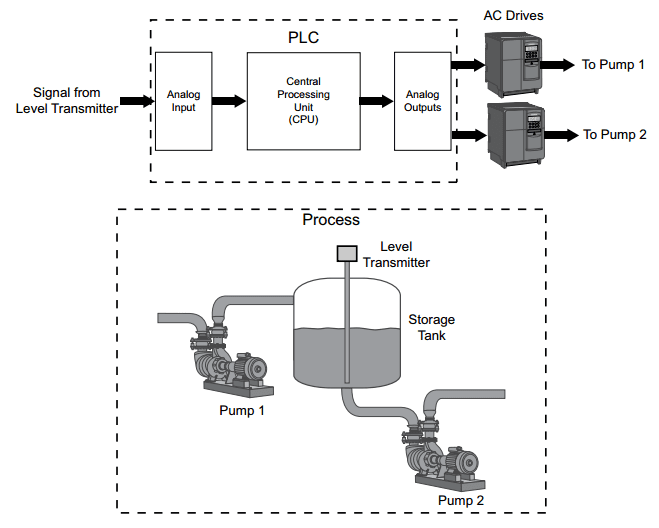
Analog outputs from a PLC are often supplied directly or through signal converters or transmitters to control valves, instruments, electronic drives or other control devices which respond to analog signals. For example, analog outputs from the PLC could be used to control the flow of fluid in a process by controlling AC drives (Picture 2). Rather than simply turning the AC drives on or off, which could be accomplished by discrete outputs, analog signals can be used to control the output of the AC drives. This would allow the speed of the pumps to be varied dynamically in response to changes in process requirements.


Picture 2: Analog Output Example

Discrete Inputs/Outputs


Motor Starter Example


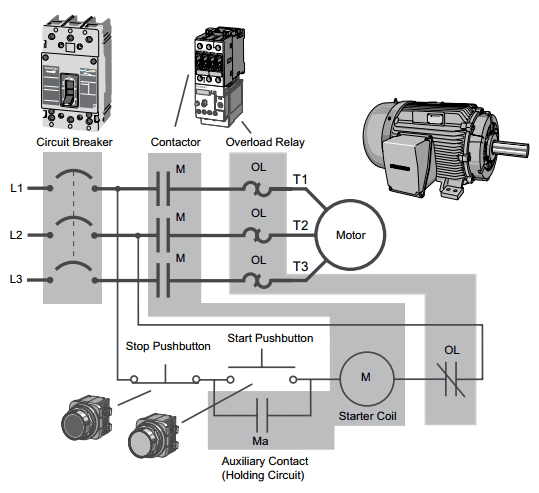
A more practical, and only slightly more complex application is start-stop control of an AC motor. Before examining the PLC application, first consider a hardwired approach. The following line diagram (Picture 1) illustrates how a normally open and a normally closed push button might be connected to control a three-phase AC motor. In this example, a motor starter coil (M) is wired in series with a normally open, momentary Start push button, a normally closed, momentary Stop push button, and normally closed overload relay (OL) contacts.


Picture 1: Motor Starter Example


Momentarily pressing the Start push button completes the path for current flow and energizes the motor starter (M). This closes the associated M and Ma (auxiliary contact located in the motor starter) contacts. When the Start button is released, current continues to flow through the Stop button and the Ma contact, and the M coil remains energized.
The motor will run until the normally closed Stop button is pressed, unless the overload relay (OL) contacts open. When the Stop button is pressed, the path for current flow is interrupted, opening the associated M and Ma contacts, and the motor stops.


PLC Motor Control


This motor control application can also be accomplished with a PLC. In the following example (Picture 2), a normally open Start push button is wired to the first input (I0.0), a normally closed Stop push button is wired to the second input (I0.1), and normally closed overload relay contacts (part of the motor starter) are connected to the third input (I0.2). These inputs are used to control normally open contacts in a line of ladder logic programmed into the PLC.


Picture 2: PLC Motor Control


Initially, I0.1 status bit is a logic 1 because the normally closed (NC) Stop push button is closed. I0.2 status bit is a logic 1 because the normally closed (NC) overload relay (OL) contacts are closed. I0.0 status bit is a logic 0, however, because the normally open Start push button has not been pressed. Normally open output Q0.0 contact is also programmed on Network 1 as a sealing contact. With this simple network, energizing output coil Q0.0 is required to turn on the motor.


Program Operation


When the Start push button is pressed, the CPU receives a logic 1 from input I0.0. This causes the I0.0 contact to close. All three inputs are now a logic 1.
The CPU sends a logic 1 to output Q0.0. The motor starter is energized and the motor starts.
The output status bit for Q0.0 is now a 1. On the next scan, when normally open contact Q0.0 is solved, the contact will close and output Q0.0 will stay on even if the Start push button is released.
When the Stop push button is pressed, input I0.1 turns off, the I0.1 contact opens, output coil Q0.0 de-energizes, and the motor turns off.


Adding Run and Stop Light Indicators


The application can be easily expanded to include indicator lights for run and stop conditions. In this example (Picture 3), a RUN indicator light is connected to output Q0.1 and a STOP indicator light is connected to output Q0.2.
The ladder logic for this application includes normally open Q0.0 contact connected on Network 2 to output coil Q0.1 and normally closed Q0.0 contact connected on Network 3 to output coil Q0.2. When Q0.0 is off, the normally open Q0.0 contact on Network 2 is open and the RUN indicator off. At the same time, the normally closed Q0.0 contact is closed and the STOP indicator is on.


Picture 3: Run and Stop Indicator states


When the Start button is pressed, the PLC starts the motor. Output Q0.0 is now on. Normally open Q0.0 contact on Network 2 is now closed and the RUN indicator is on. At the same time, the normally closed Q0.0 contact on Network 3 is open and the STOP indicator light connected to output Q0.2 is off.


Further Expansion


The PLC program can be further expanded to accommodate a wide variety of commercial and industrial applications (Picture 4). Start/Stop push buttons, selector switches, indicator lights, and signaling columns can be added. Motor starters can be added for control of additional motors. Over-travel limit switches can be added along with proximity switches for sensing object position. Various types of relays can be added to expand the variety of devices being controlled. As needed, expansion modules can be added to further increase the I/O capability. The applications are only limited by the number of I/Os and amount of memory available for the PLC.


Picture 4: Expansion Elements